Batik in the UK
What is batik in the Western world? Is it a painting, a scarf, a book, a bag…? After nearly two months in the UK, searching in vain for the answer, I have come to realize that batiks here are whatever the artist wishes them to be. Unlike in Indonesia, Malaysia or Japan, they are not bound by tradition and there are no limits to the artist's creativity. For the most part, each batik is the work of a single artist and an expression of their personal beliefs and ideals. Although I set out to understand batiks in the UK, what I discovered was the artists who created them and the individual lives that they lead. Batiks here are as unique and diverse as the artists themselves and to know the work, one must first know their creator. WHO then, are these UK batik artists, why do they use this medium and what are they trying to express?
Unlike the Asian countries that do have a batik tradition, there is no “center” of batik production in the UK. Thus, I have had to travel across the entirely of this country in order to seek out each artist individually in their studios which is almost always a part of their house. For the most part, I was welcomed as a guest in their home and was touched by how willing these artists were to open their lives to me. Even after just a few days in each place I feel as if I have made numerous connections and friends across the UK. Although I had already seen their batiks displayed online, in books and during exhibitions, it was only after meeting each artist in person and in their domestic environment that I truly understood their work.
Upon arrival to England, I took a taxi directly to Cumonor House School in Sussex, the private school in which batik artist Rosi Robinson teaches. Not only was I greeted by one artist, but a classroom full of energetic children working on their creations. Culture shock was not something I expected to experience, but after ten months in Asia, I was dazed to see so much white skin and astonished by the wealth all around me. Even more amazing was the freedom these children have to express themselves and I wondered if they really appreciate how lucky and privileged they are? At the same time, it was sad to see the competitive and individualistic society in which they live. Even at their young age, they are already stressing out over entrance exams and scholarship applications. From Rosi, I learned the art of patience and how to teach batiks to children slowly - by starting with wax crayons before moving on to hot wax. Education is only one aspect of her life however and underneath her calm demeanor, I found a spontaneous, open-minded and well traveled artist as well. Retuning home from a long day at work, she still manages to find time to work in her home studio as well as plan for her upcoming departure to study batiks in China!
In Brighton, I found Jenn Adamson, the treasurer of the Batik Guild and an artist in her own right. As a retired teacher and headmistress, she shared a similar patience and mannerism as Rosi. Her bright, sunny home and loving family are reflected in the vibrant batiks she creates. Without the stress of work or money, she is free to experiment with many materials and the batiks that emerge from her small studio/tool shed in the garden may be on anything from cloth, paper, wood or even gold fabric. It was liberating to follow her example and I was especially excited about the use of newspaper to capture a moment in time. Painting wax onto velvet was also a whole new experience and my visit to Wales and Conwry Castle was captured in it’s fuzzy texture.
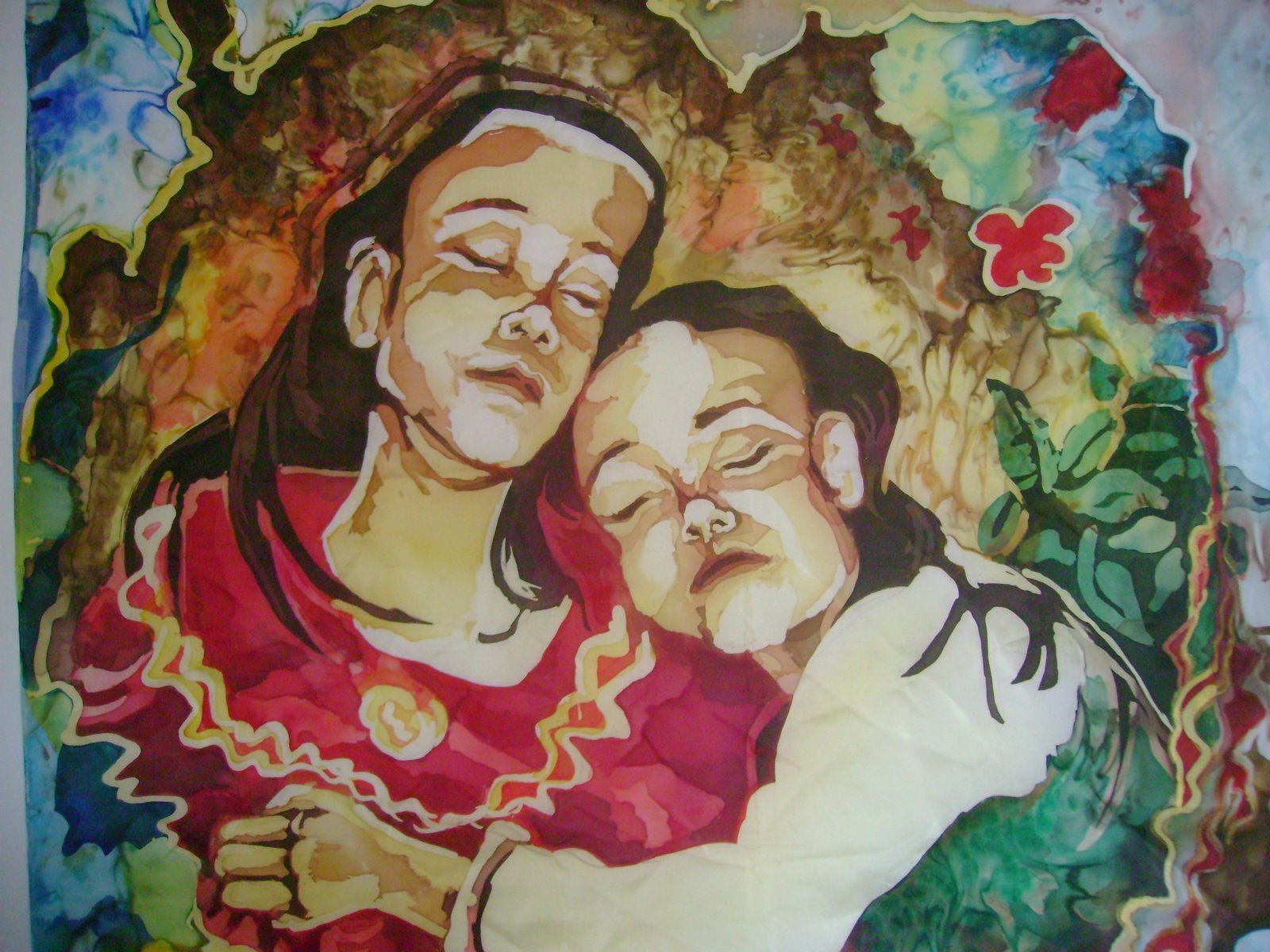
Detailed, warm and loving describes Marina’s Elphick’s batiks, home and family. Working mostly figuratively, she paints in a studio next to her renovated farmhouse and her two children are her favorite subjects. Although she was discouraged from batik in fine art school, Marina’s strong affinity toward the medium convinced her to be true to herself and her art. Nevertheless, the formal training she received there shows through in her paintings which are as much “fine art” as any in museums or galleries. Starting with a detailed drawing on cloth, she then uses a variety of tjanting pens and brushes to create subtle lines, textures and shading. The result are the most detailed and illustrative batiks I have yet to come across in all of my travels.
Entering Jennifer Sharpstone’s home was like stepping into a fantasy world of color, plants, textures and smells. Organized chaos may be the best definition of her studio in the back garden, which has expanded to the kitchen, where she does most of her batik work. Like the variety of objects in her home, Jenny’s creations range from photos, sculpture, acrylics, pastels, etc. and wax-resist is only one of the many media in which she works. Her batiks reflect this diversity and are seen hung on lampshades, framed on walls, draped on tables and even pinned onto the ceiling!
Robin Paris’s batiks reflect her love for the environment and the gorgeous Cornwall countryside in which she lives. They are a statement of her belief in sustainability and the need to protect the fragile ecosystem in which we live. Not only do the images speak of these ideals but the materials in which they are made must be good and healthy for the Earth as well. It is absolutely incredible how much time and thought must go into creating sustainable batiks. Where was the cloth made? Who makes them and was it a fair trade? Which dyes are least toxic? Is it possible to use natural dyes? Where does the wax come from and how are the bees treated? The questions seem never-ending. As a full-time artist, Robin must deal with these issues as well as: organizing and looking for storage space, labeling slides, uploading websites, finding gallery space and preserving/framing her pieces. Although we did manage to process indigo leaves, make an indigo vat and dye our organic cotton batiks in the week I was there; what I learned went beyond the realm of creation. From Robin, I discovered what it means to be a working artist and how to live, eat, breathe and work for one’s ideals and beliefs. I will never again produce a batik piece without concern for the implications of my work on the environment and also a prayer of gratitude for the materials I am using.
With these newly formed ideals in mind, I departed for Isabella Whitworth’s home in Devon and found a kindred spirit. Although she started as a graphic designer, her travels in Indonesia inspired a move toward textile art. Beginning as a silk painter, she discovered the greater possibilities with batik and it has since become her medium of choice. In her studio just opposite the bedroom, she paints silk scarves that she then markets to various galleries in the area. Even after the scarf is finished however, the tedious work of labeling, pricing and marketing begins. Like Robin, she has become concerned with the environmental implications of her work and is experimenting with natural dyes and fibers. The hard work of studying plant species, their chemical properties and how to use their dyes is nothing compared to the creative difficulties that they cause. With a few exceptions such as indigo blue, most natural dyes need to be boiled with the fabric - the heat making the wax-resist technique impossible. For three years now, Isabella has been dedicated to finding a way around this problem and in the process, discovered a talent for research and writing. With a spacious home and an incredibly supportive husband, Isabella will no doubt be successful in any creative venture she decides to pursue. Under her gentle tutelage, I dyed my own scarf with natural dyes and am now completely addicted. I can’t wait to conduct my own experiments and explore the possibilities for myself. Who knows where this path will lead?
Isabella’s friendship with the well-known indigo expert Jenny Balfour-Paul was the break that got me a meeting with this remarkable woman. As one of the few dyes that does not require heat to set, indigo has been used throughout the world for batik and it’s story is synonymous with the wax-resist process. Jenny has spent a lifetime traveling and recording the uses, functions and processes of creating dye from the indigo/woad plant and it is reflected in the incredible textiles that cover almost every inch of her grand home.
The English have a long history of trade with other countries and Jim and Diane Gaffney are an example of the connection between East and West. This husband and wife team travel all over the world (focusing on Thailand, Indonesia and Turkey) buying gorgeous handmade batiks to bring back to their shop, Textile Traders in Bishop’s Castle, Shropshire. Stepping into their store was like going back to Asia and I was amazed to see how different the Indonesian batiks and equipment looked in their new home. As Chairwoman of the Batik Guild, Diane has been an invaluable resource for my travels within the UK and abroad and I had already been in contact with her for some time before I arrived in Indonesia. It was still a surprise however to meet her by chance there in that batik studio in Java where I was living. Not only was Diane there for business, but also to distribute the Batik Guild sponsored “Java Fund” to the Indonesian batik community in support of this important aspect of their heritage. Sales are only part of the Gaffney’s work and it is the interactions with the people and cultures they meet in their travels that is most valuable to them. Diane and Jim insist on knowing exactly where their products come from and make sure that the artisans were paid fairly for their work. The lectures, talks and workshops they give about what they have seen and learned are vital to spreading a greater understanding and appreciation for their products so that customers will appreciate them for what they are worth.
On the way to a natural dye/fiber fair titled “Wonderwool Wales,” Diane and Jim dropped me off in paradise – a.k.a the incredibly beautiful home of Jane Meredith located right on the river Wye. This artist of batik lampshades now focuses mostly on natural dyes on wool and takes advantage of the ample space around her home to grow all kinds of dye plants. It was amazing to see the variety of colors that she could create simply from seeds, dirt and water! Jane’s company “Plant Dyed Wool” was also participating in the Wonderwool fair and tagging along gave me the opportunity to meet many other natural dye and textile artisans such as Helen Melvin, whose book on indigo dying Robin and I were using, as well as Alison Dykin, whose “Pure Tinctoria” brand of natural dyes I was using with Isabella. What a great feeling of completion in having met so many of my natural dye idols!
“Natural” is hardly the word that came to mind upon seeing Pat Hodon’s florescent purple hair at the train station in Sheffield. That was the moment my sustainable batik discoveries ended and the mechanical ones began. Pat’s batiks are a result of layers of paper, silk, digital prints, thread, glue, etc. and unlike anything I have ever seen before. As a graduate of a fine arts college, she has been trained in many methods of artistic expression and is not afraid to push the limits and boundaries of batik. A steady job at a local college allows her the freedom to experiment and create work that has meaning for her. Pat’s spacious studio in the attic is just as clean, orderly and meticulous as the batiks she creates. The two huge laser printers and state-of-the-art computer equipment may not look anything like tjanting pens or wax pots but are nevertheless tools of her craft. Pat’s works are about transparencies, color and light; and after 30 years, the batik medium is still the only way for her to achieve the layers and intensity of color that her work requires.
As all of this traveling in the UK has shown me, batik artists in Europe are few and far between. For the most part, they work in solitude without the community that batik/rozome artists in Asia enjoy. To encourage and support each other, the Batik Guild was formed in 1986 to bring members together through meetings, exhibitions lectures, workshops and newsletters. Their Annual Gathering Meeting was in Whitby and I arrived two days early to help batik artist, BG magazine editor, and organizer of the event, Heather Gatt with the finishing touches. The result was an incredible weekend of workshops, discussions, brainstorming, and inspiration for the 20 members who attended. It was truly incredible to be surrounded by a group of people who shared a similar passion and love for batik. I was inspired by their vision for the future of batik in the art world and motivated to do my part to help.
Staying with Heather Gatt for a few days after the conference gave me further insight into the life of a working artist. After a full day of running workshops, going to galleries, getting work framed, and more; she must still make time to produce her art. After 32 years of batik experience, Heather admits that she does question why she still works in this difficult and under-appreciated medium, and has explored other media such as oil and watercolor painting to express herself. Somehow however, she always seems to return to the wax pot, her tjanting tools and the unexpected surprises of batik on cloth.
My visit with Noel Dyrenforth in London the night before I depart for West Africa was the perfect capstone to my UK batik tour. As the president and founder of the Batik Guild, he is definitely “the man” to see and I feel privileged to have met him. After over 30 years of teaching and studying batiks all over the world, Noel feels that Japan has been the greatest influence for his work. The skill and precision of the artists there resonate with his own detailed paintings which emphasize control above all. The disputes between Rozome, Batik, Fine Art or craft are a pointless distraction that for him is simply not worth entering. Wax and dyes are Noel’s chosen media in which to explore himself and the world around him and it is the color, line and form that matter, not the name of the technique that created them.
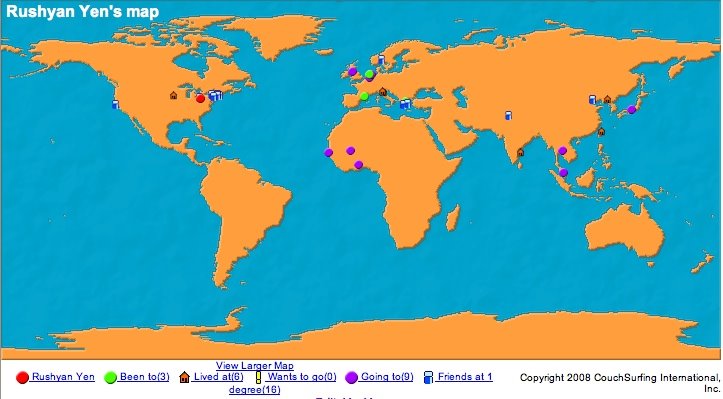
After visiting so many different artists from all walks of life, I am a few steps closer to understanding what it means to be an artist and how batiks can fit into the art world. The frustrations of Western batik artists in getting their work recognized as “fine art” and not “craft” makes me question my own definitions of the medium and wonder how I will fit in as an artist. The end of my Watson journey is in sight and this experience in the UK has made me question my future goals. Should I find a “real” job when I return or am I prepared to pursue the difficult life as an artist and a BATIK artist to boot!? In Asia, I felt comfortable with what I have but after just a few weeks in England, I feel greed and desire flowing once again through my blood. It is not enough for me to be an unknown craftsperson of batik fabrics – I want to be an artist, have a career, make money and be FAMOUS! Tomorrow, I am leaving for West Africa where I will spend nearly three months in The Gambia, Senegal, Mali and Ghana. Hopefully it will bring my ego back down to earth – at least until the next time I come down with “fine art fever.”